



EXPECTS SIMPSON TO REVEAL HAND Charlotte Believes He Will Tie Up Loose Ends AMAZED BY WITNESSES Mills Girl Cannot Understand How They Can Contradict Themselves - Disgusted with Attitude of Spectators in Courtroom
The Hall - Mills murder case involved Edward Wheeler Hall, an Episcopal priest, and Eleanor Mills, a member of his choir with whom he was having an affair, both of whom were murdered on September 14, 1922, in Franklin Township, New Jersey.
[Sources: https://en.wikipedia.org/wiki/Hall%E2%80%93Mills_murder_case]
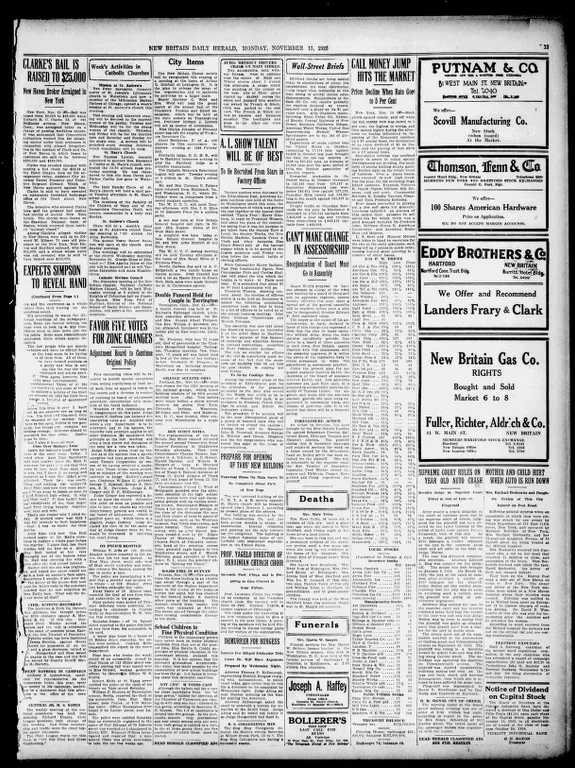
BY CHARLOTTE MILLS
(Copyright, 1926, Famous Features Syndicate, Inc.)
Somerville, N. J., Nov. 15 - A strange thought comes to me as I wait for another week of the trial to begin. I have been thinking that this whole case so far has been very much like the gnarled old tree under which my mother and Dr. Hall were killed.
Many phases of the evidence presented in court are like branches on the tree - a branch here and a branch there. Sometimes the evidence has seemed like disconnected branches, but this week Senator Simpson will connect them and show how they all lead to the trunk of the tree and downward to the roots, against which my mother and Dr. Hall were found dead. No matter how far the case seems to go astray at times, everything always leads back to those poor bodies at the foot of the tree.
Of course the lawyers for Mrs. Hall and her two brothers are trying to saw off whole branches of evidence, but the tree is tough; and the strong trunk always remains. They will not be able to chop up this tree of evidence for "souvenirs" like the original crabapple tree was chopped up. It is too strong with the vital sap of love and hate and memories.
Yesterday, during an automobile ride, we passed near De Russeys lane. I had to shudder when I saw the great crowds of curiosity seeking people there. Sometimes I am just disgusted with the whole world.
Glad Week Is Ended
I am glad that the first phase of the trial - the present action of the state's case - is drawing to a close. It will probably be over by the middle of the week. Then the defense will have its day in court. What can they do, I wonder, to tear down the evidence that has been built up?
It seems very strange to me that some of the witnesses that were on the stand last week changed their testimony in several important details. How can they do that?
The truth is the truth and four years doesn't change that. I believe Senator Simpson will have more to say yet about Louise Geist. I wouldn't be surprised to see some fireworks about her pretty soon.
I can't say that I face the reopening of the trial with much vigor, although I spent the week-end at the home of a girl friend in New Brunswick. All day yesterday my mind was haunted by those letters from Dr. Hall to my mother they read in court.
I have never read them myself, and I couldn't sit in the courtroom while they were being read. I had them in my possession quite a while after mother was killed, but I always felt that if I read them I would be committing a sacrilege against her love. Then I was tricked out of them four years ago and they were published for the whole world to read.
But there is one consolation for me. Although I don't know what is in those letters, I am sure they show how beautifully my mother and Dr. Hall loved, and they ought to be a revelation to those who think theirs was a profane love.
The sp[e]ctators must be entertained.
Spectators Think It is a Show
I can't quite get accustomed to the attitude of most of the spectatators in the Somerville courtroom. A person, not knowing, would get the impression that he was watching some dress rehearsal and that those seated around were friends of the actors or critics, ready to find fault and just as ready to give praise.
There aren't many actual outside spectators here - most of those occupying seats are either state witnesses or reporters, but as far as the majority of them is concerned, it is all a great show. When Senator Simpson makes some brilliant remark, there is usually a buzz among those present - some expressing approval, others disapproval.
Even some of the state witnesses seem to forget that this is a murder trial and that they are important figures in it. One of them on the stand, several days ago - I don't want to mention any names - seemed more concerned with how the answers impressed the reporters and the courtroom as a whole rather than their bearing on the questions asked.
[continued on page 13 of the original]
It's interesting to watch the different reactions of the newspapermen. Some are forever writing, too busy even to look up at any time. Others seem to take down just the big joints. Some seem tremendously interested, while others appear detached.
The few people who are merely [s]pectators and have no official busi-[illegible] at the trial seem to be having ?e [illegible] of their lives. All of them, ?ly [illegible], have formed opinions as ?s [illegible] guilty and who is not; ?em [illegible] like the way the trial ?conducted [illegible] and others don't. o[f] them agree, however, that [pr]etty good entertainment. [E]ntertainment! Think of it! My [moth]er murdered, and some of these [peop]le making a holiday of the trial! [Thr]ee persons on trial for their lives amuse a ha[n]dful of spectators! [illegible] [illegible] ?eatin? [illegible]
When this trial is over I don't [w]ant to see another one as long as ? live. I'm tired and disgusted. Only [t]he memory of my mother lying [t]here in the open, bullets in her poor [b]ody, her throat cut, sustains my sinking courage. Someone should be punished for that crime. Justice must be done.
But I wish it were all over.
Cries Over Mother's Love
Again my mother's heart was laid bare in the court room today. I cried when Aunt Elsie Barnhardt told how mother loved Mr. Hall. It was easy for any[o]ne to see that they were in love, Aunt Elsie said, and it was, too, I knew it, as young and innocent as I was, the[y] didn't seem ashamed. Their lo[v]e was everything, and nothing else mattered. Au[n]t Elsie told how they were plannin[g] to go away to Japan as soon as I had finished high school. O, why did they wait? If they hadn't been too considerate of me, they might have been living happily together now, man and wife.
That's one reason why I cried today. It seemed some way that I was the obstacle to their happiness - that I was to blame for their deaths.
Aunt Elsie told how Mrs. Hall seemed angry at Dr. Hall's attentions to mother a whole year before the murder. I know that, too. Once mother told me how on a picnic Mrs. Hall looked at her very strangely out of the bushes when Dr. Hall was covering her with a [r]obe after she had almost fainted.
Mother told me she was frightened, and hoped she never would see such a look on anyone's face again. Sometimes I wonder if she ever did.
The driver of the hearse that took poor Dr. Hall's body to the cemetery testified that he saw scratches on Mrs. Hall's face. What will the defense make of that?
From New Britain Herald, November 15, 1926, pages 1 and 13. Reproduced unchanged.
About this text
Reproduced unchanged from New Britain Herald, November 15, 1926, pages 1 and 13.
This text reflects the language, attitudes and errors of its time. A Century Late publishes it as a historical document.
According to Wikipedia:
All three defendants at the trial of the Hall - Mills murder case were acquitted of charges on December 3, 1926. Edward Wheeler Hall's wife and her brothers had been accused of committing the murders of Hall and Eleanor Mills, and were acquitted in a 1926 trial. The prosecuting attorney in the Hall - Mills murder case was Alexander Simpson.
The trial in the Hall - Mills murder case lasted about thirty days and garnered huge national attention, largely because of the social status of the wealthy Stevens and Carpender families.
Eleanor Mills and James had two children, Charlotte E. Mills, who lived from 1906 to 1952, and Daniel Mills, who lived from 1910 to 1992.
[Sources: https://en.wikipedia.org/wiki/Hall%E2%80%93Mills_murder_case]
Yesterday's paper
November 14, 1926.
Receive the original news from the press of 100 years ago, daily, weekly or monthly. Subscribe by January 1, 2027 and get
20% off for life!
Today's paper
November 15, 1926. The original articles, with the text exactly as it appeared and scans of the original newspaper pages, from that day’s editions of the following publications:Seward Daily Gateway, Washington Post, New York Times, New Britain Herald, St. Louis Post-Dispatch, Imperial Valley Press, Daily Kennebec Journal, Chicago Daily Tribune, Atlanta Constitution, and Evening Star.



You do.
EXPECTS SIMPSON TO REVEAL HAND Charlotte Believes He Will Tie Up Loose Ends AMAZED BY WITNESSES Mills Girl Cannot Understand How They Can Contradict Themselves - Disgusted with Attitude of Spectators in Courtroom
The Hall - Mills murder case involved Edward Wheeler Hall, an Episcopal priest, and Eleanor Mills, a member of his choir with whom he was having an affair, both of whom were murdered on September 14, 1922, in Franklin Township, New Jersey.
[Sources: https://en.wikipedia.org/wiki/Hall%E2%80%93Mills_murder_case]
BY CHARLOTTE MILLS
(Copyright, 1926, Famous Features Syndicate, Inc.)
Somerville, N. J., Nov. 15 - A strange thought comes to me as I wait for another week of the trial to begin. I have been thinking that this whole case so far has been very much like the gnarled old tree under which my mother and Dr. Hall were killed.
Many phases of the evidence presented in court are like branches on the tree - a branch here and a branch there. Sometimes the evidence has seemed like disconnected branches, but this week Senator Simpson will connect them and show how they all lead to the trunk of the tree and downward to the roots, against which my mother and Dr. Hall were found dead. No matter how far the case seems to go astray at times, everything always leads back to those poor bodies at the foot of the tree.
Of course the lawyers for Mrs. Hall and her two brothers are trying to saw off whole branches of evidence, but the tree is tough; and the strong trunk always remains. They will not be able to chop up this tree of evidence for "souvenirs" like the original crabapple tree was chopped up. It is too strong with the vital sap of love and hate and memories.
Yesterday, during an automobile ride, we passed near De Russeys lane. I had to shudder when I saw the great crowds of curiosity seeking people there. Sometimes I am just disgusted with the whole world.
Glad Week Is Ended
I am glad that the first phase of the trial - the present action of the state's case - is drawing to a close. It will probably be over by the middle of the week. Then the defense will have its day in court. What can they do, I wonder, to tear down the evidence that has been built up?
It seems very strange to me that some of the witnesses that were on the stand last week changed their testimony in several important details. How can they do that?
The truth is the truth and four years doesn't change that. I believe Senator Simpson will have more to say yet about Louise Geist. I wouldn't be surprised to see some fireworks about her pretty soon.
I can't say that I face the reopening of the trial with much vigor, although I spent the week-end at the home of a girl friend in New Brunswick. All day yesterday my mind was haunted by those letters from Dr. Hall to my mother they read in court.
I have never read them myself, and I couldn't sit in the courtroom while they were being read. I had them in my possession quite a while after mother was killed, but I always felt that if I read them I would be committing a sacrilege against her love. Then I was tricked out of them four years ago and they were published for the whole world to read.
But there is one consolation for me. Although I don't know what is in those letters, I am sure they show how beautifully my mother and Dr. Hall loved, and they ought to be a revelation to those who think theirs was a profane love.
The sp[e]ctators must be entertained.
Spectators Think It is a Show
I can't quite get accustomed to the attitude of most of the spectatators in the Somerville courtroom. A person, not knowing, would get the impression that he was watching some dress rehearsal and that those seated around were friends of the actors or critics, ready to find fault and just as ready to give praise.
There aren't many actual outside spectators here - most of those occupying seats are either state witnesses or reporters, but as far as the majority of them is concerned, it is all a great show. When Senator Simpson makes some brilliant remark, there is usually a buzz among those present - some expressing approval, others disapproval.
Even some of the state witnesses seem to forget that this is a murder trial and that they are important figures in it. One of them on the stand, several days ago - I don't want to mention any names - seemed more concerned with how the answers impressed the reporters and the courtroom as a whole rather than their bearing on the questions asked.
[continued on page 13 of the original]
It's interesting to watch the different reactions of the newspapermen. Some are forever writing, too busy even to look up at any time. Others seem to take down just the big joints. Some seem tremendously interested, while others appear detached.
The few people who are merely [s]pectators and have no official busi-[illegible] at the trial seem to be having ?e [illegible] of their lives. All of them, ?ly [illegible], have formed opinions as ?s [illegible] guilty and who is not; ?em [illegible] like the way the trial ?conducted [illegible] and others don't. o[f] them agree, however, that [pr]etty good entertainment. [E]ntertainment! Think of it! My [moth]er murdered, and some of these [peop]le making a holiday of the trial! [Thr]ee persons on trial for their lives amuse a ha[n]dful of spectators! [illegible] [illegible] ?eatin? [illegible]
When this trial is over I don't [w]ant to see another one as long as ? live. I'm tired and disgusted. Only [t]he memory of my mother lying [t]here in the open, bullets in her poor [b]ody, her throat cut, sustains my sinking courage. Someone should be punished for that crime. Justice must be done.
But I wish it were all over.
Cries Over Mother's Love
Again my mother's heart was laid bare in the court room today. I cried when Aunt Elsie Barnhardt told how mother loved Mr. Hall. It was easy for any[o]ne to see that they were in love, Aunt Elsie said, and it was, too, I knew it, as young and innocent as I was, the[y] didn't seem ashamed. Their lo[v]e was everything, and nothing else mattered. Au[n]t Elsie told how they were plannin[g] to go away to Japan as soon as I had finished high school. O, why did they wait? If they hadn't been too considerate of me, they might have been living happily together now, man and wife.
That's one reason why I cried today. It seemed some way that I was the obstacle to their happiness - that I was to blame for their deaths.
Aunt Elsie told how Mrs. Hall seemed angry at Dr. Hall's attentions to mother a whole year before the murder. I know that, too. Once mother told me how on a picnic Mrs. Hall looked at her very strangely out of the bushes when Dr. Hall was covering her with a [r]obe after she had almost fainted.
Mother told me she was frightened, and hoped she never would see such a look on anyone's face again. Sometimes I wonder if she ever did.
The driver of the hearse that took poor Dr. Hall's body to the cemetery testified that he saw scratches on Mrs. Hall's face. What will the defense make of that?
From New Britain Herald, November 15, 1926, pages 1 and 13. Reproduced unchanged.
About this text
Reproduced unchanged from New Britain Herald, November 15, 1926, pages 1 and 13.
This text reflects the language, attitudes and errors of its time. A Century Late publishes it as a historical document.
From New Britain Herald, November 15, 1926, pages 1 and 13. Reproduced unchanged.
About this text
Reproduced unchanged from New Britain Herald, November 15, 1926, pages 1 and 13.
This text reflects the language, attitudes and errors of its time. A Century Late publishes it as a historical document.
According to Wikipedia:
All three defendants at the trial of the Hall - Mills murder case were acquitted of charges on December 3, 1926. Edward Wheeler Hall's wife and her brothers had been accused of committing the murders of Hall and Eleanor Mills, and were acquitted in a 1926 trial. The prosecuting attorney in the Hall - Mills murder case was Alexander Simpson.
The trial in the Hall - Mills murder case lasted about thirty days and garnered huge national attention, largely because of the social status of the wealthy Stevens and Carpender families.
Eleanor Mills and James had two children, Charlotte E. Mills, who lived from 1906 to 1952, and Daniel Mills, who lived from 1910 to 1992.
[Sources: https://en.wikipedia.org/wiki/Hall%E2%80%93Mills_murder_case]
Yesterday's paper
November 14, 1926.
Receive the original news from the press of 100 years ago, daily, weekly or monthly. Subscribe by January 1, 2027 and get
20% off for life!
Today's paper
November 15, 1926. The original articles, with the text exactly as it appeared and scans of the original newspaper pages, from that day’s editions of the following publications:Seward Daily Gateway, Washington Post, New York Times, New Britain Herald, St. Louis Post-Dispatch, Imperial Valley Press, Daily Kennebec Journal, Chicago Daily Tribune, Atlanta Constitution, and Evening Star.