


MRS. GIBSON TO TELL STORY IN HALL TRIAL FROM A STRETCHER
The report adds that Charles E. Waite, a firearms expert who was to have testified for the prosecution, died in his rooms in the Hotel Latham, and that Simpson said Mr. Waite's evidence would be given by his partner, Major Calvin E. Goddard.
The report writes in its own voice of "the morbid who sought admittance to the tiny church to satisfy their curiosity", and says the Rev. J. Mervin Pettit, rector of St. John's, has made it a practice to turn them away. The report states that Assistant Attorney General Alexander Simpson said he would read into the record of the trial the love letters written by Mrs. Mills to the rector, and that he would try to get additional facts on "the intrigue" through the evidence of members of St. Mary's Guild, a girls' organization in the parish of St. John the Evangelist. The report states that Mrs. Hall, Willie Stevens and Henry Stevens are on trial for the murder of the Rev. Edward W. Hall and Mrs. Eleanor R. Mills, and it records no verdict.
Ambulance will carry state's chief witness to court Wednesday. Hall neighbor summoned. Woman to testify on willie stevens as marksman - he aimed at cat, but hit a dog. Firearms expert dies. Partner of c. e. waite will testify in his place - mrs. mills's letters to be read today.
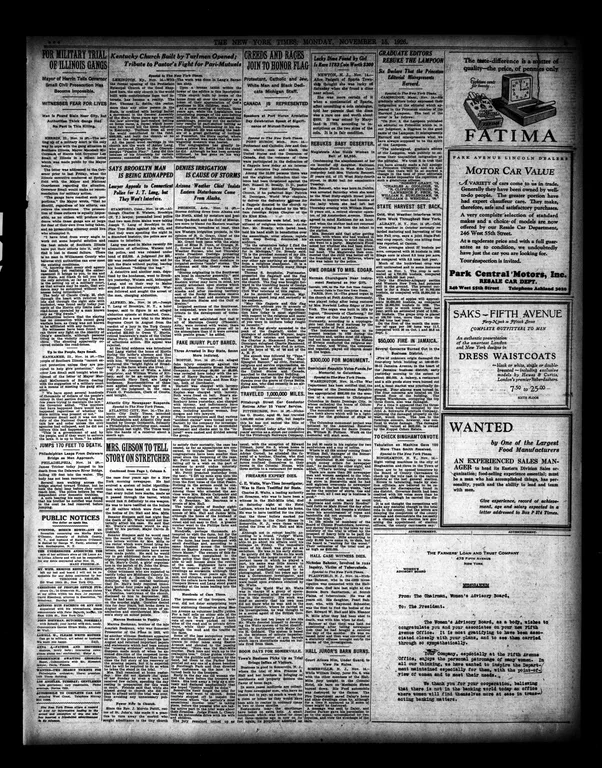
Mrs. Jane Gibson probably will take the stand in the Hall-Mills trial on Wednesday, according to announcement last night by Assistant Attorney General Alexander Simpson, after he had talked with her in the Jersey City Hospital. He said that her condition remained the same and that she had held the gain made on Thursday when she underwent a blood transfusion.
Mrs. Gibson will make the trip from Jersey City to the Court House at Somerville, N. J., in an ambulance. She will be carried to the stand on a stretcher, there to tell her story of the death of the Rev. Edward W. Hall and Mrs. Eleanor R. Mills, for whose murder Mrs. Frances Stevens Hall and her brothers, Willie Stevens and Henry Stevens, are on trial.
Another woman entered the ranks of State witnesses yesterday when it was learned that Mrs. Anna W. Vermilye of Newark had been subpoenaed last Friday by Captain Harry Walsh of the investigators. Mrs. Vermilye lived four years ago in the home of Alan H. Bennett, whose home is directly back of the Hall house in New Brunswick. Mr. Bennett has testified that in the morning following the night of Sept. 14, 1922, he was aroused by the barking of his dog. He said he went to the porch and talked to William Phillips, a night watchman, who said he had just seen a woman whom he had not recognized enter the Hall home.
Linked With Willie Stevens.
The purpose in calling Mrs. Vermilye, however, will not be in connection with this episode. It was explained that the State was interested in Mrs. Vermilye's testimony as having a possible bearing on Willie Stevens as a marksman.
It was said that four years ago Stevens went gunning for cats which had overrun the Hall grounds. In shooting at one of the cats he missed, but hit the Bennett dog in the lip, the bullet doing no serious injury.
Captain Walsh gave Mrs. Vermilye the subpoena originally issued to former Deputy Police Commissioner Joseph A. Faurot, who testified last week that fingerprints on a calling card picked up at the murder scene were those of Willie Stevens. Faurot's name on the subpoena had been scratched out and Mrs. Vermilye's name written in. It was learned that shortly before Walsh visited Mrs. Vermilye, two men whom she believed to be Jersey City detectives came to her home and represented themselves as "detectives hired by the Hall family." They questioned her about the cat-hunting episode. Counsel for the defense denied yesterday that they had sent detectives to her and suggested that Mrs. Vermilye's visitors might have been State troopers.
Prospective Witness Dies.
Charles E. Waite, a firearms expert who was to have testified for the prosecution, died early yesterday morning in his rooms in the Hotel Latham. He had been ill for several days, suffering from an embolism. The immediate cause of death, however, was a heart attack. Mr. Waite worked on the case four years ago for a New York morning newspaper.
[continued on page 3 of the original]
He had evolved a system of bullet identification which was based on the theory that every bullet bore marks, made as it passed through the barrel, which would link it definitely to one weapon. He was to have testified on the bullets of .32 calibre which were fired into the bodies of Dr. Hall and Mrs. Mills.
Senator Simpson said last night that the death of Mr. Waite would not materially affect his case. He said that Mr. Waite's evidence would be supplied by his partner, Major Calvin E. Goddard.
Senator Simpson said he would read into the record of the trial today the love letters written by Mrs. Mills to the rector which were found lying between their bodies. There are twelve letters, and their contents have never been made public. He said he would try to get additional facts on the intrigue through the evidence of members of St. Mary's Guild, a girls' organization in the parish of St. John the Evangelist, where Dr. Hall was rector.
Other witnesses who are expected to testify today are Middlesex County Detective Ferd A. David, Dr. Otto H. Schultze, who will combat testimony that Dr. Hall's body required immediate burial four years ago, and Jacob Van Peltz, who is to relate how Ralph V. Gorsline, vestryman of the church, disclosed to him in September, 1922, that he had been in De Russey's Lane on the murder night. Gorsline denied this for four years, but broke down in August after twenty-one hours of examination and corroborated Mrs. Gibson's story on minor points.
Marcus Beekman to Testify.
Marcus Beekman, brother of the late Azariah Beekman, who was Somerset Prosecutor of the Pleas in 1922, will be another witness. Beekman appeared at one of the preliminary hearings last August and returned important papers and statements which had been among the "missing evidence" which Senator Simpson made much of when he assumed dire[c]tion of the reopened investigation. Beekman refused then to disclose the full story of his recovery of the missing papers, but it is expected that he will be required to do so when he takes the stand in the trial.
Mrs. Hall remained at home yesterday. She did not disturb the quiet of her Sunday by even a walk and received few callers, spending the day resting in preparation for this week in court. Friends said that while she missed going to church she did not plan to attend until the trial was over, thus avoiding any unnecessary publicity.
Fewer Now in Church.
Since the Rev. J. Mervin Pettit, rector of St. John's, has made it a practice to turn away the morbid who sought admittance to the tiny church to satisfy their curiosity, the case has ceased, as far as appearances are concerned, to intrude itself there. The congregations have been smaller than usual since the reopening of the case, Mr. Pettit said, but he attributed the falling off to a wish on the part of members to avoid undue notoriety and to their fear of photographers.
Mr. Pettit preached yesterday from the text: "I lift up mine eyes unto the hills whence cometh my help" - taken from the first verse of the 121st Psalm. Nothing in the sermon could be construed as a reference to the trial. Among those who attended the services were Mrs. Edwin Carpender and her two daughters, and Mr. and Mrs. W. G. Bearman. Mr. Bearman is a cousin of Mrs. Hall.
The usual quota of Sunday sightseers drove past the church and the homes of Mrs. Hall and James Mills, although the home of the husband of the murdered woman is on a side street and not easy to find. A greater number went to the Phillips farm and to the famous lane.
Hundreds, perhaps thousands, attempted to visit the farm, but for the first time they were turned back. Part of the farm has been developed with small dwellings and, according to a name blazoned across the terraced front on Easton Avenue, is now "Pine Grove Manor." The owners of this development have complained to the State police that they have been unable to sell houses since the revival of the case. Sightseers have even tried to remove parts of the unsold dwellings as souvenirs, although they were not there four years ago, they said, and shingles, even panes of glass from the cellars have been taken. State Troopers Bowen and Lang stood guard yesterday at the lanes leading into the farmhouse.
Hundreds of Cars There.
The presence of the troopers, however, did not deter enterprising boys from stationing themselves along Easton Avenue as volunteer traffic guides. For a half mile on either side of the entrance to De Russey's Lane hundreds of cars were parked on both sides of the road and in private driveways, while their owners walked through the mud and the traffic to the farm.
Some of the less scrupulous youngsters stationed themselves at the entrance to other lanes along Easton Avenue and shouted to the passing motorists: "Here was the Hall-Mills murder. Park here and walk up to the crabapple tree." Other guides virtually took the gullible and curious by the hand, led them to the Parker home pointed out any one of a dozen benches in Buccleugh Park and then directed their customers up the lane to be turned back by the troopers.
Early in the day one old woman visited the farm before the troopers got there. She took away a twig as a souvenir and declared emphatically that she hoped "justice would be done."
Somerville itself forgot the trial for the day and went to church. Some tourists stopped off to inspect the courtroom where "the century's most sensational murder trial" is taking place, before the persons who are taking active part in the trial were about their firesides. Judge Frank L. Cleary took an automobile drive with his wife and children.
The jury remained locked up as usual, with the exception of Edward Tillman, juror No. 5, whose home is in Raritan. Escorted by Patrolman Adrian Cornell, he attended the funeral of a brother, Charles, who died Friday in Rahway. The other eleven jurors confined themselves to their rooms in the Colonial House, with three sorties to a restaurant for meals.
From New York Times, November 15, 1926, pages 1 and 3. Reproduced unchanged.
About this text
Reproduced unchanged from New York Times, November 15, 1926, pages 1 and 3.
This text reflects the language, attitudes and errors of its time. A Century Late publishes it as a historical document.
Text: read from the Internet Archive's microfilm scan by A Century Late; article boundaries by A Century Late.
According to Wikipedia:
All three defendants in the Hall - Mills trial were acquitted of the charges on December 3, 1926.
While the authorities addressed the confusion after the murders of Edward Wheeler Hall and Eleanor Mills, curiosity-seekers trampled the scene, took souvenirs, and passed Hall's calling card among the crowd. The physical evidence in the Hall - Mills murder case was thus severely compromised.
[Sources: https://en.wikipedia.org/wiki/Hall%E2%80%93Mills_murder_case]
Yesterday's paper
November 14, 1926.
Receive the original news from the press of 100 years ago, daily, weekly or monthly. Subscribe by January 1, 2027 and get
20% off for life!
Today's paper
November 15, 1926. The original articles, with the text exactly as it appeared and scans of the original newspaper pages, from that day’s editions of the following publications:Seward Daily Gateway, Washington Post, New York Times, New Britain Herald, St. Louis Post-Dispatch, Imperial Valley Press, Daily Kennebec Journal, Chicago Daily Tribune, Atlanta Constitution, and Evening Star.


You do.
MRS. GIBSON TO TELL STORY IN HALL TRIAL FROM A STRETCHER
The report adds that Charles E. Waite, a firearms expert who was to have testified for the prosecution, died in his rooms in the Hotel Latham, and that Simpson said Mr. Waite's evidence would be given by his partner, Major Calvin E. Goddard.
The report writes in its own voice of "the morbid who sought admittance to the tiny church to satisfy their curiosity", and says the Rev. J. Mervin Pettit, rector of St. John's, has made it a practice to turn them away. The report states that Assistant Attorney General Alexander Simpson said he would read into the record of the trial the love letters written by Mrs. Mills to the rector, and that he would try to get additional facts on "the intrigue" through the evidence of members of St. Mary's Guild, a girls' organization in the parish of St. John the Evangelist. The report states that Mrs. Hall, Willie Stevens and Henry Stevens are on trial for the murder of the Rev. Edward W. Hall and Mrs. Eleanor R. Mills, and it records no verdict.
Ambulance will carry state's chief witness to court Wednesday. Hall neighbor summoned. Woman to testify on willie stevens as marksman - he aimed at cat, but hit a dog. Firearms expert dies. Partner of c. e. waite will testify in his place - mrs. mills's letters to be read today.
Mrs. Jane Gibson probably will take the stand in the Hall-Mills trial on Wednesday, according to announcement last night by Assistant Attorney General Alexander Simpson, after he had talked with her in the Jersey City Hospital. He said that her condition remained the same and that she had held the gain made on Thursday when she underwent a blood transfusion.
Mrs. Gibson will make the trip from Jersey City to the Court House at Somerville, N. J., in an ambulance. She will be carried to the stand on a stretcher, there to tell her story of the death of the Rev. Edward W. Hall and Mrs. Eleanor R. Mills, for whose murder Mrs. Frances Stevens Hall and her brothers, Willie Stevens and Henry Stevens, are on trial.
Another woman entered the ranks of State witnesses yesterday when it was learned that Mrs. Anna W. Vermilye of Newark had been subpoenaed last Friday by Captain Harry Walsh of the investigators. Mrs. Vermilye lived four years ago in the home of Alan H. Bennett, whose home is directly back of the Hall house in New Brunswick. Mr. Bennett has testified that in the morning following the night of Sept. 14, 1922, he was aroused by the barking of his dog. He said he went to the porch and talked to William Phillips, a night watchman, who said he had just seen a woman whom he had not recognized enter the Hall home.
Linked With Willie Stevens.
The purpose in calling Mrs. Vermilye, however, will not be in connection with this episode. It was explained that the State was interested in Mrs. Vermilye's testimony as having a possible bearing on Willie Stevens as a marksman.
It was said that four years ago Stevens went gunning for cats which had overrun the Hall grounds. In shooting at one of the cats he missed, but hit the Bennett dog in the lip, the bullet doing no serious injury.
Captain Walsh gave Mrs. Vermilye the subpoena originally issued to former Deputy Police Commissioner Joseph A. Faurot, who testified last week that fingerprints on a calling card picked up at the murder scene were those of Willie Stevens. Faurot's name on the subpoena had been scratched out and Mrs. Vermilye's name written in. It was learned that shortly before Walsh visited Mrs. Vermilye, two men whom she believed to be Jersey City detectives came to her home and represented themselves as "detectives hired by the Hall family." They questioned her about the cat-hunting episode. Counsel for the defense denied yesterday that they had sent detectives to her and suggested that Mrs. Vermilye's visitors might have been State troopers.
Prospective Witness Dies.
Charles E. Waite, a firearms expert who was to have testified for the prosecution, died early yesterday morning in his rooms in the Hotel Latham. He had been ill for several days, suffering from an embolism. The immediate cause of death, however, was a heart attack. Mr. Waite worked on the case four years ago for a New York morning newspaper.
[continued on page 3 of the original]
He had evolved a system of bullet identification which was based on the theory that every bullet bore marks, made as it passed through the barrel, which would link it definitely to one weapon. He was to have testified on the bullets of .32 calibre which were fired into the bodies of Dr. Hall and Mrs. Mills.
Senator Simpson said last night that the death of Mr. Waite would not materially affect his case. He said that Mr. Waite's evidence would be supplied by his partner, Major Calvin E. Goddard.
Senator Simpson said he would read into the record of the trial today the love letters written by Mrs. Mills to the rector which were found lying between their bodies. There are twelve letters, and their contents have never been made public. He said he would try to get additional facts on the intrigue through the evidence of members of St. Mary's Guild, a girls' organization in the parish of St. John the Evangelist, where Dr. Hall was rector.
Other witnesses who are expected to testify today are Middlesex County Detective Ferd A. David, Dr. Otto H. Schultze, who will combat testimony that Dr. Hall's body required immediate burial four years ago, and Jacob Van Peltz, who is to relate how Ralph V. Gorsline, vestryman of the church, disclosed to him in September, 1922, that he had been in De Russey's Lane on the murder night. Gorsline denied this for four years, but broke down in August after twenty-one hours of examination and corroborated Mrs. Gibson's story on minor points.
Marcus Beekman to Testify.
Marcus Beekman, brother of the late Azariah Beekman, who was Somerset Prosecutor of the Pleas in 1922, will be another witness. Beekman appeared at one of the preliminary hearings last August and returned important papers and statements which had been among the "missing evidence" which Senator Simpson made much of when he assumed dire[c]tion of the reopened investigation. Beekman refused then to disclose the full story of his recovery of the missing papers, but it is expected that he will be required to do so when he takes the stand in the trial.
Mrs. Hall remained at home yesterday. She did not disturb the quiet of her Sunday by even a walk and received few callers, spending the day resting in preparation for this week in court. Friends said that while she missed going to church she did not plan to attend until the trial was over, thus avoiding any unnecessary publicity.
Fewer Now in Church.
Since the Rev. J. Mervin Pettit, rector of St. John's, has made it a practice to turn away the morbid who sought admittance to the tiny church to satisfy their curiosity, the case has ceased, as far as appearances are concerned, to intrude itself there. The congregations have been smaller than usual since the reopening of the case, Mr. Pettit said, but he attributed the falling off to a wish on the part of members to avoid undue notoriety and to their fear of photographers.
Mr. Pettit preached yesterday from the text: "I lift up mine eyes unto the hills whence cometh my help" - taken from the first verse of the 121st Psalm. Nothing in the sermon could be construed as a reference to the trial. Among those who attended the services were Mrs. Edwin Carpender and her two daughters, and Mr. and Mrs. W. G. Bearman. Mr. Bearman is a cousin of Mrs. Hall.
The usual quota of Sunday sightseers drove past the church and the homes of Mrs. Hall and James Mills, although the home of the husband of the murdered woman is on a side street and not easy to find. A greater number went to the Phillips farm and to the famous lane.
Hundreds, perhaps thousands, attempted to visit the farm, but for the first time they were turned back. Part of the farm has been developed with small dwellings and, according to a name blazoned across the terraced front on Easton Avenue, is now "Pine Grove Manor." The owners of this development have complained to the State police that they have been unable to sell houses since the revival of the case. Sightseers have even tried to remove parts of the unsold dwellings as souvenirs, although they were not there four years ago, they said, and shingles, even panes of glass from the cellars have been taken. State Troopers Bowen and Lang stood guard yesterday at the lanes leading into the farmhouse.
Hundreds of Cars There.
The presence of the troopers, however, did not deter enterprising boys from stationing themselves along Easton Avenue as volunteer traffic guides. For a half mile on either side of the entrance to De Russey's Lane hundreds of cars were parked on both sides of the road and in private driveways, while their owners walked through the mud and the traffic to the farm.
Some of the less scrupulous youngsters stationed themselves at the entrance to other lanes along Easton Avenue and shouted to the passing motorists: "Here was the Hall-Mills murder. Park here and walk up to the crabapple tree." Other guides virtually took the gullible and curious by the hand, led them to the Parker home pointed out any one of a dozen benches in Buccleugh Park and then directed their customers up the lane to be turned back by the troopers.
Early in the day one old woman visited the farm before the troopers got there. She took away a twig as a souvenir and declared emphatically that she hoped "justice would be done."
Somerville itself forgot the trial for the day and went to church. Some tourists stopped off to inspect the courtroom where "the century's most sensational murder trial" is taking place, before the persons who are taking active part in the trial were about their firesides. Judge Frank L. Cleary took an automobile drive with his wife and children.
The jury remained locked up as usual, with the exception of Edward Tillman, juror No. 5, whose home is in Raritan. Escorted by Patrolman Adrian Cornell, he attended the funeral of a brother, Charles, who died Friday in Rahway. The other eleven jurors confined themselves to their rooms in the Colonial House, with three sorties to a restaurant for meals.
From New York Times, November 15, 1926, pages 1 and 3. Reproduced unchanged.
About this text
Reproduced unchanged from New York Times, November 15, 1926, pages 1 and 3.
This text reflects the language, attitudes and errors of its time. A Century Late publishes it as a historical document.
Text: read from the Internet Archive's microfilm scan by A Century Late; article boundaries by A Century Late.
According to Wikipedia:
All three defendants in the Hall - Mills trial were acquitted of the charges on December 3, 1926.
While the authorities addressed the confusion after the murders of Edward Wheeler Hall and Eleanor Mills, curiosity-seekers trampled the scene, took souvenirs, and passed Hall's calling card among the crowd. The physical evidence in the Hall - Mills murder case was thus severely compromised.
[Sources: https://en.wikipedia.org/wiki/Hall%E2%80%93Mills_murder_case]
Yesterday's paper
November 14, 1926.
Receive the original news from the press of 100 years ago, daily, weekly or monthly. Subscribe by January 1, 2027 and get
20% off for life!
Today's paper
November 15, 1926. The original articles, with the text exactly as it appeared and scans of the original newspaper pages, from that day’s editions of the following publications:Seward Daily Gateway, Washington Post, New York Times, New Britain Herald, St. Louis Post-Dispatch, Imperial Valley Press, Daily Kennebec Journal, Chicago Daily Tribune, Atlanta Constitution, and Evening Star.